Custom Search

2018-08-21

Jointing the top and back


20180814
I began the build by shooting the various boards: tops and backs.
After making sure that no light passed thru' the joint seam, I proceed to joint the 2 halves of the boards.
I have only 2 sets of jig to clamp the 2 halves so I joint the tops first.


Shooting the back of #10


Back of #10


Shooting the back of #11


Back of #11


Checking the top seam


Jointing the top using my jig. Tightening the rope using a wedge.


20180821
The top is removed from the jointing jig.
Next the back is glued with the same method as the top.
The glue remnants is also removed by scraping from the jointed area on the top.


After removing from the jig


Jointing the back #10, tying the rope.


Inserting the wedge


Jointing the back #11


Scraping the top joint


20180828
After the glued dried and more than 48 hours, the 2 backs are released from their jointing jigs.
Looks great!


#10 back jointed


#11 back jointed

2018-08-14

Starting on 3 new guitars: #10, #11, #12


20180814
I will be beginning a few new builds: 2 new 6-string guitar and 1 new 7-string guitar
The guitars will all be using RW back and sides with Lutz spruce top.
The RW back taps very high pitch with lots of sustain.
Think these will be interesting build, be sure to stay tuned.

2018-08-13

Repair a Ukulele


20180813
A ukulele came in for repair as the bridge came off (another case of bridge repair).
The owner has used a shoe glue to glue it back but it was not a suitable glue.
So I had remove the glue remnants.
Upon removing it I noticed the top was scribed with a lot of XXXXX and this is the cause of failure...
Normally top should not be scribed with xxxx.
Glue work best with fitting surfaces and if the top is damaged with xxxx scribes, the surface will not be fitting and the chances of bridge coming off is bigger.
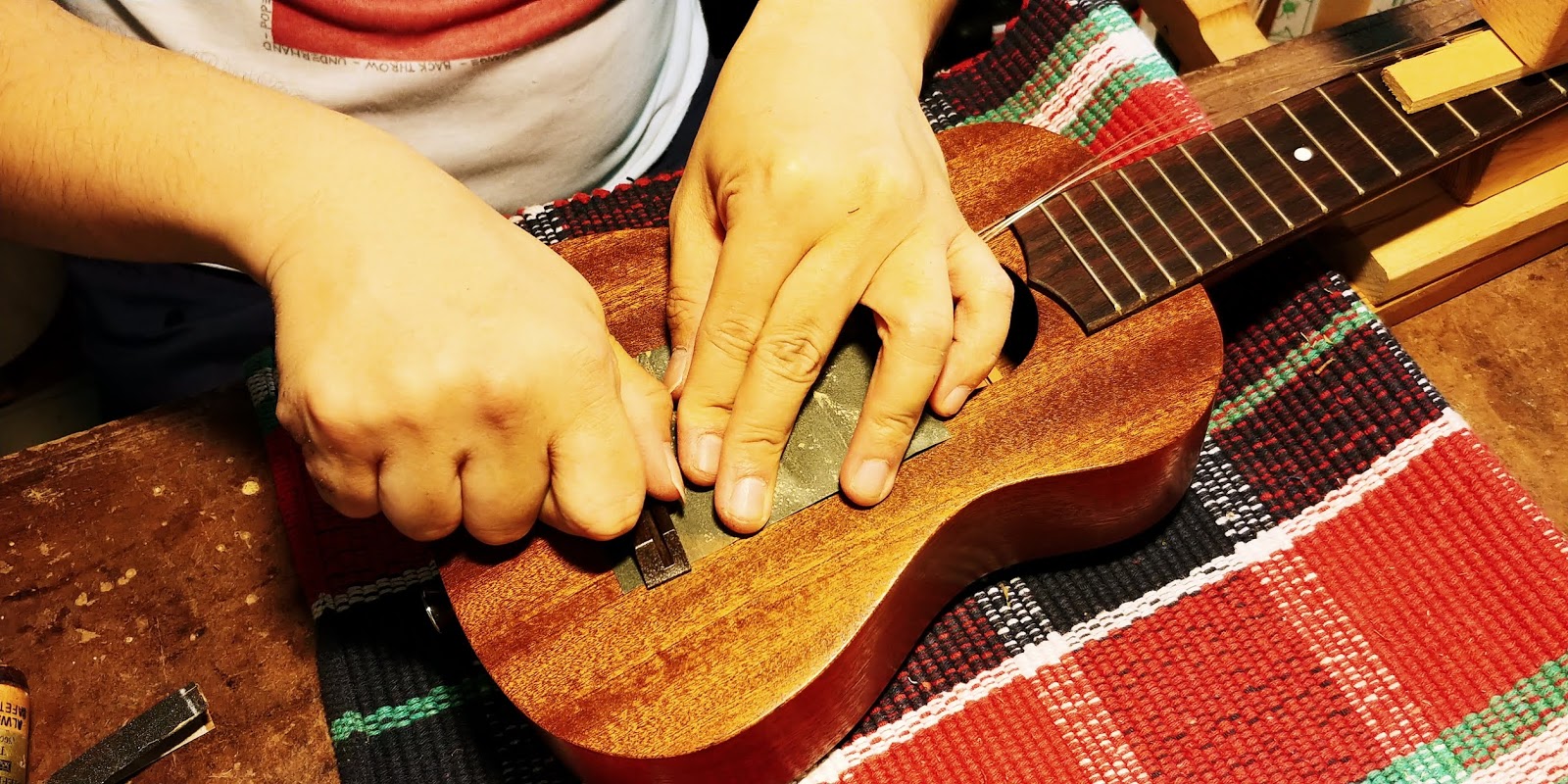
After cleaning the surfaces and sanding both side to have better fit, I applied the glue and glued back the bridge to the top.


Scraping the glue remnants on the bridge


Sanding the bottom of the bridge


Removing the glue remnants on the top.


Sanding the top.


Fitting both surfaces


Closeup of the scribing marks on the top (likely cause of the failure)


Gluing the bridge to the top.

Repair a guitar


20180801
I have a guitar coming in for a bridge repair.
Nothing too out of the ordinary.
But I did noticed that the top has some wavy curve across, but I did not see any damages to the butt area.
So I think the cause of the bridge coming loose is probably due to changes in RH.
Anyway for this bridge repair I use a caul underneath the top and clamp with 3 bridge clamps.
Before applying the glue, I clean the surface with sandpaper.
After that I applied the glue and clamp.


The gap developing at the back of the bridge. The top has a noticeable wavy curve.


Cleaning the surface with sand paper


Apply glue and clamped


Another view


Caul and clamp used


The bridge glued nicely


20180813
The guitar has been strung up for about a week and the bridge still stays strong.
I prepare a new nut for the guitar with a closer string spacing.
The maker has put a pin in the middle of the nut slot which makes the making of the nut a bit more challenging.
So I just make the nut to fit the slot and file the string spacing accordingly.


New nut with closer string spacing.


Guitar all strung up and ready to play.

2018-06-22

Installing the binding and purfling


20180622
Next I cut the binding channel on the back of the guitar.
Normally I will cut the top binding channels first for but this time round I cut the back bindings
Also I bent the bindings.
I thought ebony was hard to bend but they came out pretty good.
Think overall my method had improved as I use another iron to heat the other side of the wood.
That really helps in the bending.

I describe a bit about my new method of bending.
Actually there isn't much difference from my previous method.
Previously I will use 2 blocks to support the back of the curve portion during the bend.
However the heat is only coming from the hot pipe side.
So this might result in some breakage for some woods that don't want to be bent.
With this method, the concept is very similar.
The bend at the curve part is now supported by the iron; but I can only support one side instead of two.
I need the other hand to hold the bindings.
The good part is the iron will also apply the heat to the back of the wood which greatly reduce the breakage.
Also by pulling the wood thru the compressing heat mold formed by the pipe and the iron, the wood acquires a gradual bend shape.
This will also reduce the amount of sanding required for the woods after bending.

After cutting the channel, I fit the binding and they fit perfectly.
I did some adjustment to the trimmer to cater for the arch back surface.
Thus the channel came out referenced the sides instead of the top.


Bending the bindings using a hot pipe and an iron. Works great!


After cutting the binding channel. Chips everywhere.


Test fitting the binding.


2018-06-20

Repair a guitar with bridge problem


20180417
a guitar came into my workshop for a bridge repair.
This is not the usually bridge lifting off problem, but the tie-block has came off.
Naturally I was surprised as this is the first time I have seen such a problem.
Anyway I thought the fix will be simple: to glue back the tie block
There owner wanted to change the whole bridge but I digressed.
  • There were no missing pieces
  • There was no problem with intonation / i.e. saddle placement
Hence I stick to my plan to glue back the tie-block
After gluing I strung up the guitar


Tie-block broken


Glue back the tie-block


Strung up


20140424
Unfortunately, after a few days, the tie-block came out again to my surprise.
True enough the glued joint is stronger than the wood itself, but the break as another layer in the tie-block
What this means was that the bridge wood has some sort of weakness in it.
So the solution now is to change bridge entire and build a new bridge.


Tie-block broke off again - different layer


Still with the strings attached


20180507
I began to remove the existing bridge.
Before that I scribed the edges to prevent the lacquer from chipping off as I remove the bridge.
I also took measurements of the scale length / compensation and bridge height.
To my surprise, the bridge began to crumble and broken in pieces as I remove it.
I followed my usual way of removing the bridge heating the platter knife and insert in between the bridge and top.
No heat was apply to the top
This was to ensure no excessive heat was applied to prevent other glued parts from coming loose from the heat
So the problem was with the bridge wood after all.
But I wonder what caused the wood to crumbled like that.

Finally after 45 minutes or so I manage to remove the bridge cleaning.
Surrounding woods are undamaged.


Scribing the edges to prevent lacquer chipped out


Heating and inserting the knife under the bridge. No heat was applied to the top. No water was used.


Done


20180531
I began to work on the bridge blank.
First by scraping and sanding the bottom arc to fit the top.
Also I sanded the top to remove the unevenness of left by the bridge removal.
Finally I sanded the bridge blank to fit the top.

Then I saw away the bridge wings and the bridge began to form in shape.


Scraping the bottom of the bridge blank


Sanding the top


Sanding the bridge to fit the top


Saw away the wing of the blank


Bridge taking shape.


20180619
Half way I decide to use pre-made bridge as I can complete the process faster.
And the fit was quite good.
So I use epoxy to glue the bridge.
Not my usual habit to glue the top but in this case as there were some gaps in the surface, a epoxy glue will be a better guarantee.
So I fitted the bridge and applied the glue to both surface, followed by clamping.


Bridge glued.


20190620

Next I removed the clamp and make a new saddle, change the tuning machine and string up the guitar.
The bridge glue job looks good.
And the guitar sounded nicely.
I touched up some of the finishes but they certainly don't look perfect though.


Bridge glued nicely, new saddle made.


Tuning machines changed

2018-05-07

Closing the box


20180430
Finally the box is closed.
Before that I remembered to weigh the back.
However, I forgot to record the tap tone of the box and the back...

I did not do a dry run for the clamping but it was mistake.
As I glue the back, I could not insert the clamp on the heel area as the solera was blocked from below.
I had forgotten to allow some space for the clamps to go in.
Anyway I just clamp the rest first then proceed to shift the woods below to allow the clamp to go in.
So rule of thumb, always do a dry run if you have not been doing the process for a long time.


One last look before closing the box.


Ensure there is enough block to spread the clamping pressure


Apply the glue and heat them up so that they will not gel so fast


Glued and clamped.


20180507
I removed the clamps and check the fit.
No problem with the fit.
After that I proceed to trim the overhangs.
During clamping it helps to have about 5mm or so of overhang.


Trimming the overhang - assortment of tools used: Rebate plane, chisel, LA block plane, scraper etc...


Trimming the overhang


Overhangs trimmed


The back view