I also glue up the headplate for the neck.
It was pretty easy with no fuss.
I just apply the HHG to the veneer one by one, and finally paste on the IRW (from back) on the veneer.
The only thing is have to work fast with the HHG, so I didn't have time to take more pictures.
But I did use up my batch of HHG and had to remix the glue.
I didn't weigh the HHG but instead remember the viscosity of the fluid when I mixed it.
Applying HHG
More HHG
Gluing the Headplate
Clamping it
Mixing HHG
Checking the crystal dissolving in the hot water
There was some gaps so I apply more HHG and clamp tighter
Gaps closed and the excess headplate / veneer leveled.
Planing the excess veneer/headplate
Leveled
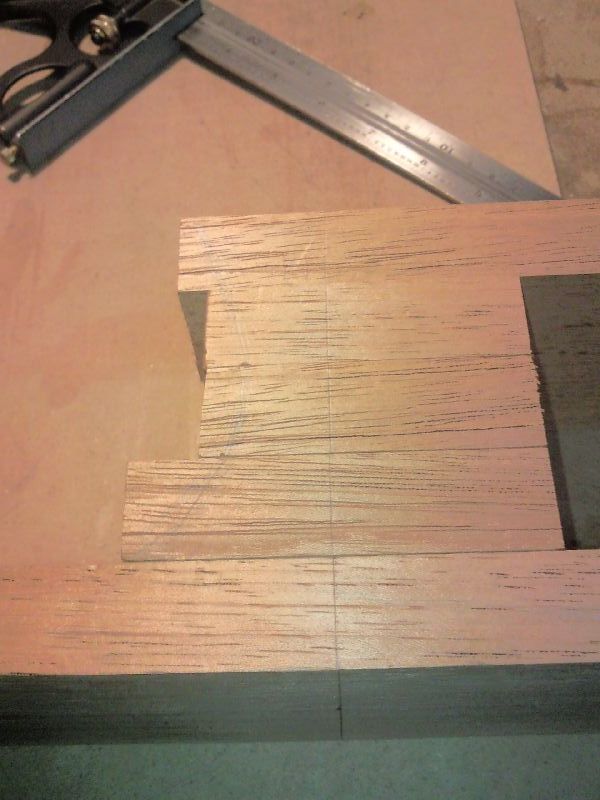
Next is to cut the excess part from the end of the headplate so that it can support the nut.
Because the head is at an angle (15 deg) to the neck, we need to make the slot vertically down perpendicular to the neck.
So I plane a support block using the head and shooting board method.
I put some scrap wood to protect the neck.
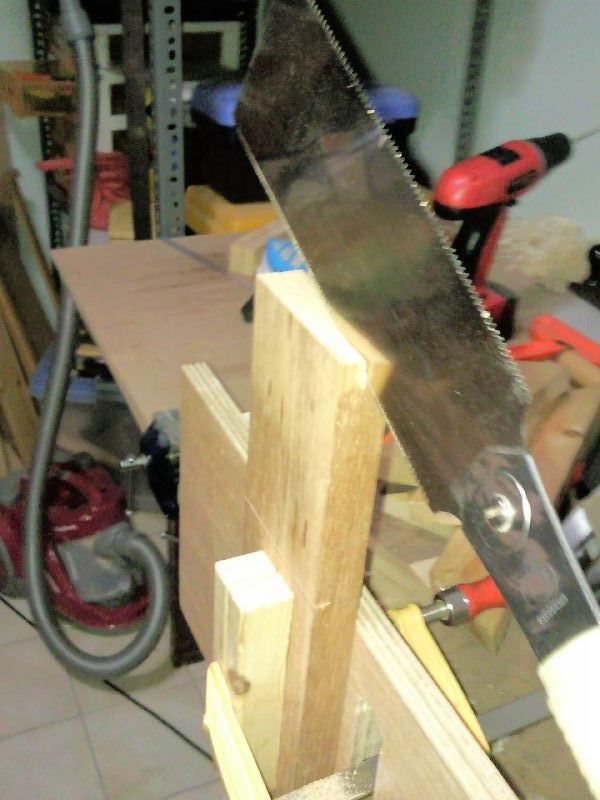
Finally when it's down I use my ryoba saw and started sawing the protruding headplate and veneer.
Finally I clean up with a chisel and sanding block
Looks good.
Marking the starting of the nut.
Marking using white color pencil
Shoot / Plane the support block to correct angle
Aligning the support block to the line drawn.
Starting sawing. (pic is abit blur)
Sawing the headplate 1/2 way
Sawing the veneer
Cut and clean up with chisel and sandpaper.
Next I proceed on with the neck making.
I measure the 12 fret marking with 5mm for the nut and 325mm for the 12 fret mark.
This is a 650 (1/2 of it is 325) scale length guitar.
Marking the 12 fret
12 fret mark 325mm from nut space
Nut allowance 5mm
Then I add another 125mm for the elevated neck and cut off the excess
I use another neck blank for the stack heel.
I square shoot the end grain of the cut blocks.
and prepare the block for gluing.
Cutting the excess
Cut!
All blocks cut
Aligning the blocks
Drawing the 12 fret line and curve of the heel
I proceed to cut the slope on the neck for the elevated neck part.
After removing my sawing, I plane the rest of the neck to be almost flush with the solera.
A bit of fitting more to go.
Cutting the slot with a block (hidden) as a guide.
Sawing the excess part.
The slope sawn.
Planing using a shoulder plane so that I can reach all the way into the edge.
Close up view.
The main bulk is done using block plane
Almost done. You can see the pencil line there is some more allowance to go for fitting.
To fit into the solera I need to cut the wings of the elevated part of the neck.
Conventional fingerboard is < 65mm (62mm at the 12th fret) for this part I set width at 69mm for some allowance.
I also have to cut the protruding part of the solera at the 12th fret.
After cutting and fitting into the solera I check the slope of the elevated fingerboard part.
My blank was definitely higher: So I have a choice of lowering it to fit the solera or add another part into the solera.
I am tending toward the latter as I think a higher elevated fingerboard would be easier to play.
Point to consider is also the slope of the doming of the topboard that will be forced by the elevated fingerboard.
Sawing the wings off. I have to becareful as sawing along grain can easily cause splitting.
As a safeguard I cut the crossgrain cut at the 12 fret to prevent over splitting in case it happens
Done
Trimming ends at 12th fret
Trimming the width with chisel
Cutting the solera at the 12th fret
Fitted neck into the solera
Now the dilemma: fit the solera to the neck or neck to solera?
Well I solve the dilema, just raise the solera.
I feel that a too low raise fingerboard would not be effective (might as well do without).
My current neck blank's angle and height is just nice.
So I would rather the solera fit the neck blank.
Anyway I use a scrap piece of wood mark the excess angle and plane it down.
Next I glue it to the solera.
After that I glue the heel block.
The slots would need to be cut before I glue the heel block to the neck.
Planing the addition piece of wood
Gluing it to the solera
Preparing to glue the heel block
Glued. With HHG I don't have much to time to take the in between pics
As a treat this is roughly how the elevated neck will look like.
After removing the clamps
I level the additional 2 blocks to fit the neck blank.
With the heel block
Next to cut the slots in the heel block
For that I will be using my neck jig that will have a angle in the slot as defined by the jig.
The side do not join the heel block in a 90 degree but at a slight angle probably around 89 or 88 degree
I square the heel block roughly and marked out the center lines of the block.
This will be align to the neck later on.
The center line is also required for symmetry purposes.
I discover that it's impossible to clamp the heel block.
So I need to glue a scrap piece of wood to the heel block in order to cut the slots.
I glued it with 4 drops of PVA white glue; just enough to hold the block and need to remove the scrap after that.
In a normal neck I just clamp to the neck part but in this elevated fingerboard neck, I cut the heel block separately from the neck.
This cause the problem of not enough places to clamp the heel block.
The next time I can cut bottom most piece longer enough for me to clamp the heel block.
After sawing the slots I can cut the excess away for another heel block.
Squaring the heel block
Gluing a scrap piece to the wood for clamping purpose
After that I began to mark the slot.
The jig has a proble: it was not square...
I had to put a wedge to correct the angle.
Then I began sawing.
I didn't have a physical stop for me to stop sawing but use my eyes to check the sawing mark.
Once I hit the mark I will stop sawing.
Once completed I realised the angle for both sides isn't the same...
That is the problem of a poorly made jig... Think I need to rework on it.
Anyway I began sawing the back slot with a slight taper for the wedging effect.
And chisel out the in between.
Ready to saw the slot.
Marking on the heel block
Sawing the slot
Another view.
The heel block slot sawn, note the slight taper for the wedging effect of the 2nd slot?
The angle for the 2 sides isn't symmetrical need to correct that later.
Chiseling the slot
Sawing the back of the heel block
Planing it level.
Heel block with the neck.
With the top in place. Note the wedge for the top to wedge the top in between the neck.
Another view
Close up.