Custom Search

2013-10-07

Making the neck


20130429
I began to make the neck.
When I was sawing the blank for the scarf I accidentally cut my finger.
I was holding the head part for the past part of the sawing and the saw dropped on my index finger.
At first it didn't look too bad but I was bleeding quite a lot until I felt a bit faint.
Apparently the blood didn't clot until I reached home...
I check the saw blade there some part of my skin was there.
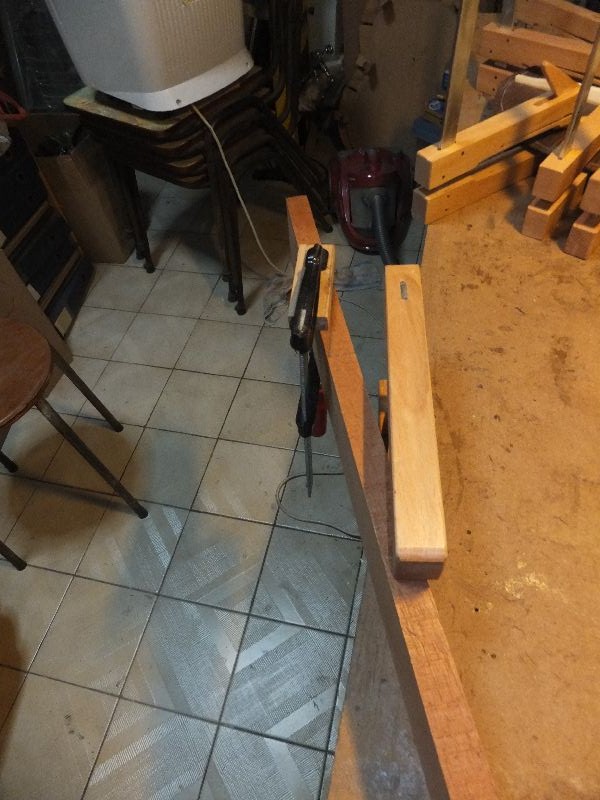
Preparing to saw the neck


Sawing the neck


Cut


Well the sawing isn't that good need to clean up with my plane.


Cleaning up the scarf joint


Close up of the red mountain cedar. Looks like Spanish Cedar


20130510
Continued on the neck, saw the pieces for the heel stack and ripped the center piece into 1/2. Then I glued a center ebony spine to the main neck. The 2 neck pieces were flipped over; left become right and right become left for better stability.


Shoot level the 2 sides of the neck


Shoot level the ebony piece


Saw the neck into 1/2s


Glue them up.


Glue and clamp


The main neck is done. Need to plane the ebony piece level with the neck.


20130802
It's been a long time since I worked on this guitar.
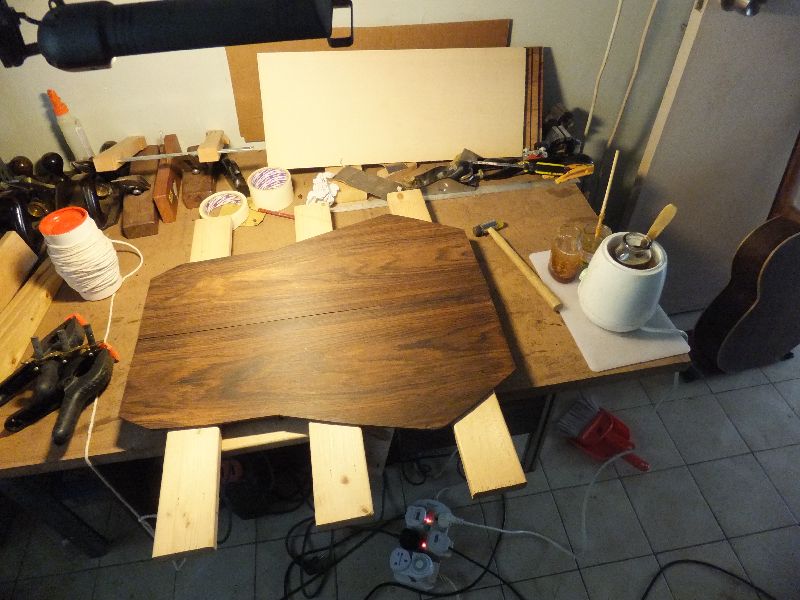
The top has been lying there in the solera for quite sometime.
Well the wait was due to several factoring including me concentrating on finishing up #3
I started to glue the neck together after confirming that the headplate size fits.
After that I can proceed to carve neck and heel; meanwhile the neck and heel block are glued separately for now.


Gluing the neck


Gluing the heel


20130807
I glued the headplate on and once it's dried it will be ready for carving the headstock shape.


Ready for gluing


Applying hide glue
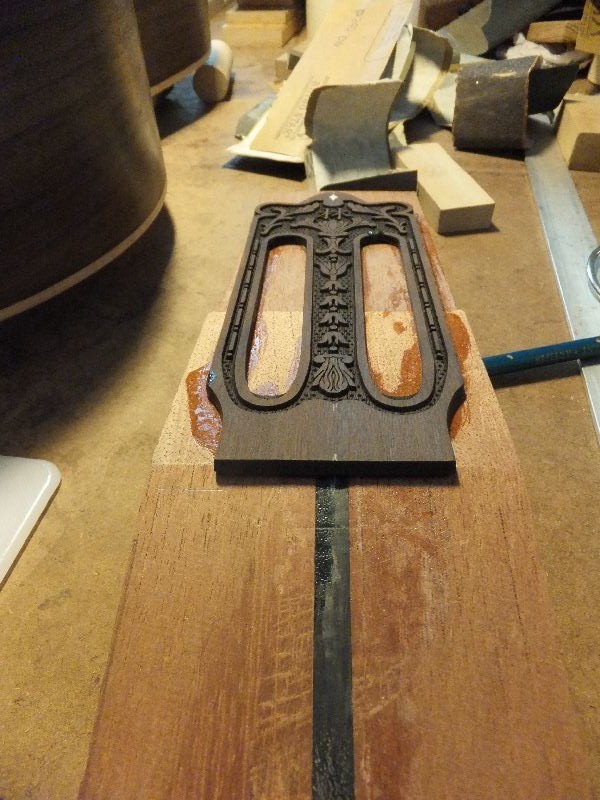

Checking alignment


Clamped


20130815
I continued on the neck.
First I planed the sides of the head until it fits the headplate.
Next I saw and file to shape the head shape
The tuner holes were next and following by the slot holes.
All were perfect until the slot holes...
Because the location of the holes were next the tuner holes the Forstner bit got suck into the tuner holes..
And the hole went off the intended place 1/2 way in depth...
Luckily it wasn't too bad and can be remedied with some sanding.
Finally I file the tuner holes section; the string ramp part
My usual neck has a straight string ramp but this one has a rounded one due to the headstock carving which wasn't doen by me.


Chiselling away at the head-neck joint part to allow space for planing


Planing the side of the headstock to fit the headplate.


Saw off the excess in the headstock.


Sawn off the excess


Chisel to shape and smoothen with file later.


Drilling the tuner hole


Drilling the slot hole


The right bottom part where the forstner bit got off tracked into the tuner hole..


Saw away the excess slot


Chop off the excess


Saw away the nut part of the headplate


Clean up with chisel


Guide holes for heel block and neck; to help align the 2 during gluing


Head stock done (quite ok except for the mistakes)


Big 2" forstner bit for the heel arc curve part. But it drifted during the drilling I had to use a smaller bit to remove the waste and finish by rasp
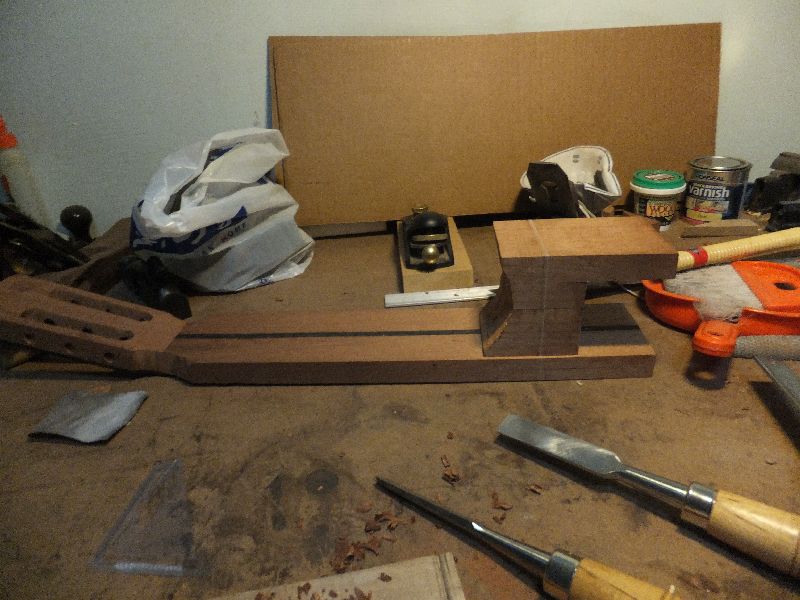

The neck ready for gluing


Glue the heel to the neck and clamped.


20130819
I began to cut the side slots and rough shape the heel.
With a 5 degree wooden block guide, I started the cut with my douzuki.
After the slotting gets deep enough the guide block is removed and continue the sawing with the douzuki.
The hard hard is the 2nd cut of the same slot/side, the guide block is clamped to the new position.
After removing the guide block the saw will tend to drift.
I had to remove some of the waste (2mm thick) by chisel and widen the kerf using my western gent saw with a scraper spacer.
After both slots are done I saw the heel front front and shape with my rebate plate.
The front curve is shape with my roller sander drill attachment.


Guide block for the slot cut, it's angle at 5 degrees offset.


Checking the slot width after sawing. The square's thickness is about 2mm


Both slot done


Sawing away the heel's waste


Rough shaped heel.

20131007
Well it has been a while since the last update.
I was caught up with something so basically didn't have time to make any progress.
So now I am basically preparing the parts for assembly and this is the final part for the neck shaping the inner heel block.
I was pondering to update it here or under pre-assembly post but decide to update here for completion sake.
So I basically saw away the excess to taper the heel block and not make it so squarish.
Squarish will work as well just matter of looks and preference.
After that I spend quite sometime shaping it making it leaner and reducing the weight.


Sawing the excess in the inner heel block so that the foot is narrower and heel (top side) is broader.


Chisel the excess away after I round off the corners with file and rasp


Next I removed the end grain with my new LN scrub plane (it's narrow enough) Other planes are too wide...


The heel block rough shaped. Need to sand it more.

2013-09-20

Bending the sides

I started to bend the sides, and to my surprise it's as easy as IRW.
I think it's probably because I thin the sides to teh correct thickness: 1.8mm at the waist and 2 at the rest.
The bending proceeded smoothly without any cracks.
The main thing to note is to allow the sides to absorb the heat before attempt to bend it.
The 2 wooden blocks which I use are very useful in supporting the bend and also to insulate the heat from my hand.
I didn't wear any gloves actually though it's a good practice to wear for protection.
And fortunately no burns this time round :)
After bending, I clamped the sides to the molds and leave it to settle in.


Preparing to bend


Checking the waist bend


Checking the LB


Clamp to mold


Done!


20130920
After the sides are in the mold, I saw off the excess ends.


Saw off the excess ends. The neck side still need to be sawn

2013-08-29

Thicknessing the sides

I had to rest a while as my R wrist was painful.
Signs of rheumatism?
I had sprained my wrist during my company's inter-department soccer game when I fell down a number of times.
Not that I am good at soccer though.
Ever since that game my wrist wasn't in good condition.
These few days the weather was very wet and hence the rheumatism sets in.

I began to thickness the sides.
With my arsenal of planes and planing cross-grain, it quite easy to bring down to thickness 2mm without any tearout.
I use both my woodies and western planes 2 jack planes one smoother cut one more aggressive.
But i do realise it's time to sharpen all the irons...


Straighten one edge (top edge)


Mark out the side points from my template


Began planing cross grain.


Smoothen it with scraper


Look at the mountain of shavings

2013-08-28

Sound clips

Guitar #3 and #1


Here is the sound clip after changing the strings.
I compared it with my #1.
I must say initially #3 sounded quite weak; but after intense playing by my friend (owner of my #2) the guitar opened up tremendously.
The bass were no longer shy the trebles projected very far.
But to the player #1 still sounded much better.
The upper notes were more even compared to my #1 but it doesn't have a really outstanding note.
My #1's B A and E notes is really outstanding compared to other notes.
This #3 all higher notes are very even.

Listen to the La Catedral clips and you will hear that in recording, the #3 sounded much open (airy).
Bass wise both are OK though not as outstanding as my WRC Gutmeier Fleta copy's bass.
In terms of volume after opening up #3 beat #1 flat.
I was quite surprised at the changes #3 underwent.


Barrio's Aconquija
Guitar #1
Guitar #3

El Testament d' Amelia
Guitar #1
Guitar #3

Lagrima
Guitar #1
Guitar #3

La Catedral 1st movement
Guitar #1
Guitar #3


I brought the #1 and #3 to office for testing and my friend brought the #2.
We compared the 3 guitar and each had very different characteristics.
My friend played various pieces including Bach's Chaconne, Concierto de Aranjuez, Albeniz Granada, Asturias and some modern fingerstyle pieces.
Listening were done at about 10 - 15 m away.
String used are quite similar, #1 and #3 have identical strings Hannbach GoldBass 825 with Aqulia nylgut treble.
#2 has D'Adario bass (I think) with Aquila nylgut treble.

#2 is the loudest amongst the treble at that distance and has the brightest tone.
It's treble is especially prominent and penetrating.
Single line melody like Concierto de Aranjuez (Adagio) sounded the best.
When played with baroque, it can sound a bit unbalanced with the bass.

#3 has most even voicing between the bass and treble and bass and the darkest tone amongst the 3.
But at the distance it can sound pretty boring.
Baroque pieces sounded the best and surprisingly fingerstyle music sounded very good.
This is because all the in between rhythmic structure can be heard quite prominently without overpowering the melody.

#1 is in between the two and Spanish pieces sounded the best in this guitar.
Projection wise is in this order #2 > #1 > #3.

It was an enjoyable evening.


My friend Kong Meng trying out the guitars. He is very vesatile musician and an expert all genre of music and instruments including classical guitar, fingerstyle guitar, Jazz guitar, violin and even drums!

He is trying the Chaconne

Do Re Mi


20130828
Some pics of my #3


The video was taken at about 20 - 25 m away. It can sure fill up the entire office!

2013-08-02

Applying the finish


20130802
I have decided to use polyurethane varnish for the guitar.
First I pore fill using the wood pore filler.
Then I sand it level.
For the PU varnish I use wipe on technique to apply the varnish.
After each coat, I sand with 240 grit to level it.
After 3 coats, I still can't get a good shine.
I think I have wait for to to cure properly and meanwhile read more about applying PU varnish.
I probably need a few more coats.


Sanding the surface


Applying the pore filler


After 3 coats


Finishing the top. The surface felt smooth but not quite the shiny yet.


Close up of the finish


After 2 more coats and level sanded with 800 grit

Jointing the back


20130802
I also jointed and glued the back.
After much pondering and selection by my friend this piece of CSARW was chosen because it looks the most stable.
It didn't react too much to the changing RH.
The other piece which was quite fragrant was warping badly.
After the glued had dried I scraped off the glue line and checked the joint (which was perfect).


Preparing the joint the back


Applying HHG


Applying the ropes to clamp the back joint


Scrape the glue remnants


Close up of the joint

2013-07-22

Making the nut and saddle


20130722
I didn't actually took many pic for this process.
The steps are quite simple: select an blank which is oversize a little and sand to fit the slot.
Once it's fitted, then I file the nut slots.
I use an 1/2 pencil to mark the height of the frets projection on the nut.
This is the lowest point the nut can go.
Similarly I put a 3mm spacer on 12th fret (4mm on bass side) and mark the projection onto the saddle using a straight edge.
After lowering and checking the action, I smoothen the nut and saddle.
I didn't do much intonation adjust 1st because my strings has not arrived.
I threw away my pack of strings...

Saddle done


Nut done

When my strings arrived (ordered from stringsbymail.com), I began the process to adjust the intonation.
I use the method taught by my friend Alex.
I first tune the strings using the 2nd fret.
Then I check 14th fret's tuning and adjust the saddle to fit.
This ensures the 2nd to 14th fret are all in tune.
Then I adjust the but to make the open 12th fret harmonic to fit the 12th fretted note.
But I was surprise I didn't need much work on the saddle and nut.
My saddle was slanted at an angle and this compensates for most of the strings.
My nut was moved forward by nearly 1 mm

The strings I used are Aquila nylgut trebles and Hannabach 825 MT pure gold bass strings.
I love this combination: the treble sparkled but yet not too overly bright.
The bass is dark and powerful.


Making the heel cap

I actually strung up the instrument before I make and glue the heel cap.
I'll describe the sound in the next post though.
The heel cap was made from the fretboard (IRW) cut-off.
I was pondering to use my ebony cut-off or stick to using the same fretboard (IRW).
In the end I think using back the same fingerboard will look better and so it shall be.
After marking the shape, I began to saw off the excess and finally plane almost to shaped.
Once glued I will file to fit the heel.


Preparing to glue the heel cap.


Glued


2013-07-11

Fretting the fingerboard


20130702
I began to fret the guitar.
At first I wanted to listen to the open strings, but I can't seem to find my box of strings.
Now to recall I might have threw the box away by mistake. Argh!!!!!
For fretting, I first level the fretboard making sure it's flat.
Then I check the slot making sure it's deep enough for the tangs.
I did this by filing away the protruding studs on the fret tang and use that to check each slot.
Finally I began to fret.

I don't have a nipper so I had to file the tang away at the ends.
It's a hard job but I am going slowly.
(I ordered some new strings so the pace is just nice for the strings to arrive)
I also file a bit of the fret tang studs away to make it easier to hammer the fret in.
Before hammering, I file the slot with a triangular file to make it less prone to chipping in case a fret jumps out during hammering.
And it did, one fret jumped when I was hammering it in and no chips at all :)
So far I only covered 5 frets and a lot more to go.


Checking whether the fret slot depth is deep enough


Filing away the fret tangs at the end


The result is quite nice but lots of hard work


Filing the slot with a triangular file to prevent chipping


And the fretting begins


20130711
I have finished fretting all the frets but I have yet to find my box of strings.
I filed the fret ends and rounded the ends like what I did for the other 2 guitar. I think I have thrown it away... Sigh.
Anyway I bought some unknown brand of strings to string it up while my shipment of new strings is still in transit.
The guitar didn't really sound as what I expected.
My #1 sounded more refined.
Think I'll for the strings to come before I make any conclusion.
Anway I have yet to adjust for the intonation until the new set of strings arrives.


Round the ends of the fret


Clamp in the last few frets. For those in the body I use clamp instead of hammering


When it's in the body, I use 2 scraper to protect the top


Check for fret levelness; 3 fret at a time.