Custom Search

2011-10-12

Trim the side

After the side is bent, I still need to do 2 things:
1) Trim the profile the side to fit the top
2) Cut the excess from the ends
As the top is dropped top (elevated neck) in which the top will curved down into the sides, the side will need to be trimmed to fit the top's curvature.
Well luckily I have made a template and it's matter of copying to the side and trim fit with a block plane.
And that's what I just did.
I also copy the back doming profile the sides too.

Cutting the excess from the ends

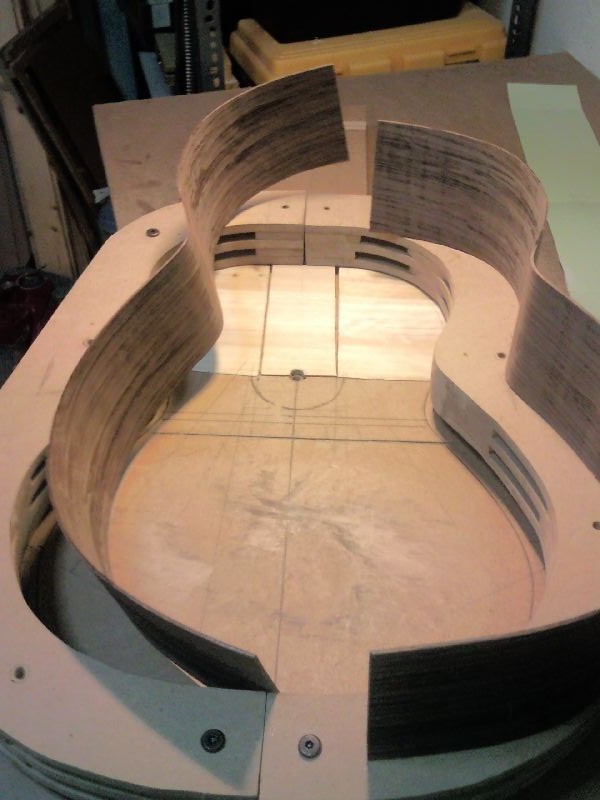
The side fits the mould now

Attaching the mould to the solera.

Copying the template to the side

Another view

Trim the side to fit the top. Note that the side is inverted top facing up.
I.e. the left side is now facing up and held on the right mould while I plane it and vice versa

Check the fit of the side to the top.

Both side done. Now my spreader after bought it for several years is put to good use.

2011-10-10

Bending the side

After thicknessing what comes next?
Bending of course.

I laid out all the things that I needed and began to bend
1) The outside mould
2) The template
3) Heat gun
4) Bending pipe
5) Sides itself.
6) Container of water (I didn't buy a spray container so I just apply it by hand)

After checking the orientation of the sides, I began to heat up the heat gun and bending.
Starting at the marking at the waist I slowly bend the wait carefully not to crack the sides.
The good thing about heat gun is I am able to heat up both sides with the hot air.
But I also need to be careful not to stand in the path of the air.
The height is right at my groin are (If you know what I meant)

Bending sure takes lots of patience.
After the waist fits the outside mould shape, I began to bend the upper bout.
And after then the lower bout.
It takes me about 30 to 45 mins for one side.
There is some spring back but well I can correct them the next time
Meanwhile I just clamp them to the outside mould and let it cool down.

All things set

Heating up the waist area

Start bending (with 2 hand of course)

The bending takes shape

Checking the bend at the waist

Bending and checking the upper bout

LB almost done. It can be squeeze into the mould.

Clamping to the mould while it cools

I touched up the previous bend to make it more fitting.
This time round I did better with a wooden block to aid the bending as advised by Alex.
After about 10 minutes it's done.
And I don't really need much clamping to the mould.

Then I started the other side starting at the waist.
The wooden block really helps: firstly to prevent my hand from being scorched;
it also prevents the cracks at the waist.
The other side has a bit of crack but none too serious.
This one is perfect.
Finally after 1/2 hour, I am done.
Much faster than yesterday.

Touch up the curves

Now I don't need to force them much into the mould

Bend the other side start with the waist. Checking the curvature at the waist

Lower bout still a lot more to go

Wet the sides with water to aid bending. Just a little will do not to soak them.

The right side almost done. Just a little spring back at the outer edge.

Clamp to the mould to cool.

Both sides done.

2011-10-04

Thicknessing the side

What's next? It will be doing up the sides.
Of course I haven't carved the peghead yet but I am waiting to purchase a good set of forstener drill bit.
The ones I had wasn't sharp enough and I don't want to ruin a good neck.

So I began to thickness the sides.
At first I tried my regular block plane, it can't cut w/o a tearout...
So I had to use my MJF high angle block instead.
It works great but a bit slow.
The thickness was about 2.8mm region
After some work I only managed to bring it down to 2.5mm
I am targeting at 2mm for easier bending.

The sides

Planing using my MJF HA block

Thicknessing in action.

Thicknessing the side is sure hard work especially with a block plane that is so small.
In the end I tried to tune the #4 making it having finer cut and even the blade.
It works just fine.
Luckily previously I have already tune the sole of the plane and mouth as tight as possible.
The plane iron is Lee Valley A2 and has been sharpened recently.
The tearout is minimal; nothing that can't be sand away.
Well in woodworking, the importance of having sharp tools cannot be overlooked.
I thickness one of the sides to 2.0mm ready for bending.
Now have to work on the other side.
Planing with the #4.

Thickness 2mm just nice.

I have completed thicknessing the 2 sides.
After some rough sanding I am ready to bend them.

I trace the back curvature from my existing Gutmeier guitar which probably was shaped using a radius dish. (Well it looks like it)
And when I cut out the template, the it's pretty much the same except that it start to slope in at the waist portion.
Anyway this is just a rough guide.
I measure the excess and cut the excess as a binding.
I probably can get about 3 binding from the excess.
After that I mark out the position of the UB, W, LB and End.
Now I am all set to bend it.

The template

Cutting the binding.

Binding cut

Marking out the UpperBout Waist LowerBout and End position

2011-10-03

Gluing the traverse brace

What's next?
Of course will be gluing of the UTB and LTB.
Once that's done, the top will be consider done for now.

I just shape up the UTB and LTB a bit more and proceed to gluing.
Due to the slope at the upper bout, I had to increase the height of the go-bar deck.
But the increase wasn't really enough, I had to bend the go-bar quite a bit.

At first when I apply the go-bar the LTB went out of vertical plane.
Luckily I remember to apply it in the same plane as the strut i.e. across the top and everything went smoothly.
As a precaution I apply 2 more go-bar to keep the UTB and LTB press into the donut.

Ready for gluing

Apply the HHG

Gluing it down

Applying the go-bar

Gluing the UTB

Apply the go-bar

Side view make sure they are glued down vertically to the top plane.

Another view. The 2 go-bar in front is to ensure the UTB pop against the donut.

Another view

What's next? That will be carving the LTB and UTB.
I simply use the small violin making plane to do the carving.
They worked great.

After releasing from the go-bar deck

Carving the profile of the traverse brace

Sanding them smooth.

The finished top.

End view

Oblique angle

Side view

Front oblique view

The final top weighs about 189.2g.
Well I thought the carving of the brace will reduce it further but it's ok.
It already reached my target of under 200g.
When I further trim the sides of the TB and the perimeter of the top, it probably will be in the range of 187g.

189.2g

Here is some taptone of the top.
The first is tapping at the bridge region.
2nd clip is tapping at the waist region: where the LTB's open aperture is.
and then at the junction at the outer fan brace and the closing brace.
then followed by some random hits all around.

Bridge area
Waist & LB

Final weight after trimming the ends of the UTB and LTB: 187.2
Not bad.
Final weight of top 187.2